American Pharaoh by Adam Cohen & Elizabeth Taylor
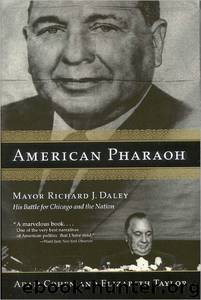
Author:Adam Cohen & Elizabeth Taylor [Cohen, Adam & Taylor, Elizabeth]
Language: eng
Format: epub, mobi
Tags: BIO000000
ISBN: 9780759524279
Publisher: Little, Brown and Company
Published: 2001-05-07T14:00:00+00:00
In early July, NAACP delegates descended on Chicago for the organization’s national convention. The summer of 1963 had already been an upsetting one for the civil rights movement. The NAACP’s Mississippi field secretary, Medgar Evers, had been shot dead by a white supremacist outside his Jackson, Mississippi, home. The local police had shown little interest in cracking the case, but they did arrest 160 mourners for marching silently in Evers’s memory. In Tuscaloosa, Alabama, Governor George Wallace had made his famous stand in the schoolhouse door to stop black students from enrolling at the University of Alabama. And in Birmingham, public safety director Eugene “Bull” Connor had greeted nonviolent protesters with snarling police dogs and high-pressure fire hoses. Chicago blacks followed all the ugly details in the pages of the Chicago Defender, whose headlines lately had been a steady drumbeat of “New Miss[issippi] Violence: Club-Swinging Jackson Cops Attack Evers Murder Protest March” and “Birmingham Still on the Edge of Racial Blow-Up!” 41
As difficult as events were down South, the NAACP delegates were also aware of the problems blacks faced in their host city — the slums, the segregated schools, the high-rise housing projects. Daley delivered an opening address to the convention that scrupulously avoided taking on any of these controversial issues. Instead, he declared that there were “no ghettos in Chicago.” He meant the remark to be uplifting, a statement of his high regard for all of the city’s neighborhoods. But Dr. Lucien Holman, the Joliet, Illinois, dentist who headed the statewide chapter of the NAACP, snapped at a startled Daley, “We’ve had enough of this sort of foolishness.” And then Holman launched into a spirited rebuttal. “Everybody knows there are ghettos here.... And we’ve got more segregated schools than you’ve got in Alabama, Mississippi and Louisiana combined.” Still, when it was over, members of the black submachine and other black allies rushed to assure Daley that they understood what he meant. It seemed to be an isolated incident. 42
The highlight of the convention was a July 4 “Emancipation Day” parade through the Loop. Daley agreed to lead a procession of 50,000 civil rights marchers through downtown. The parade, whose slogan was “Free in ’63,” was a cost-free way for Daley to make a gesture to the black community, since its focus was on the South. No homeowner in the Bungalow Belt would much care if Daley took a stand against conditions in Mississippi and Alabama. Daley marched in front of a car carrying Medgar Evers’s young widow, Myrlie, and smiled as spectators along the route rang “freedom bells” and shouted “Jim Crow must go.” Daley and the other marchers finished their hour-long trek at Grant Park, a stretch of green wedged between downtown and Lake Michigan. The parade’s organizers asked him to make a few remarks to the large crowd now gathered around the park’s bandshell. Daley had not expected the invitation, but he readily agreed. He was soon spouting his usual brand of painfully bland expressions of civil goodwill.
Download
American Pharaoh by Adam Cohen & Elizabeth Taylor.mobi
This site does not store any files on its server. We only index and link to content provided by other sites. Please contact the content providers to delete copyright contents if any and email us, we'll remove relevant links or contents immediately.
Waking Up in Heaven: A True Story of Brokenness, Heaven, and Life Again by McVea Crystal & Tresniowski Alex(37782)
Empire of the Sikhs by Patwant Singh(23069)
We're Going to Need More Wine by Gabrielle Union(19032)
Hans Sturm: A Soldier's Odyssey on the Eastern Front by Gordon Williamson(18565)
Leonardo da Vinci by Walter Isaacson(13312)
The Radium Girls by Kate Moore(12013)
Tools of Titans by Timothy Ferriss(8363)
Educated by Tara Westover(8044)
How to Be a Bawse: A Guide to Conquering Life by Lilly Singh(7466)
Permanent Record by Edward Snowden(5828)
The Last Black Unicorn by Tiffany Haddish(5627)
The Rise and Fall of Senator Joe McCarthy by James Cross Giblin(5269)
Promise Me, Dad by Joe Biden(5141)
The Wind in My Hair by Masih Alinejad(5085)
A Higher Loyalty: Truth, Lies, and Leadership by James Comey(4947)
The Crown by Robert Lacey(4802)
The Iron Duke by The Iron Duke(4348)
Joan of Arc by Mary Gordon(4098)
Stalin by Stephen Kotkin(3956)
